Alles im DetailAll of it, in detail

Das Doppel, von vorne bis hinten

The Double, from start to finish

Hier steht alles: das Problem, der Ablauf, die Fragen und das, was wir nicht versprechen. Zwanzig Minuten Lesezeit. Wer es kürzer mag, bleibt auf der Startseite.

Everything is here: the problem, the process, the questions and what we do not promise. Twenty minutes of reading. If you prefer it short, stay on the home page.

Kommt dir das bekannt vor?Sound familiar?

Ihr redet nur noch über Ergebnisse

You only talk about results any more
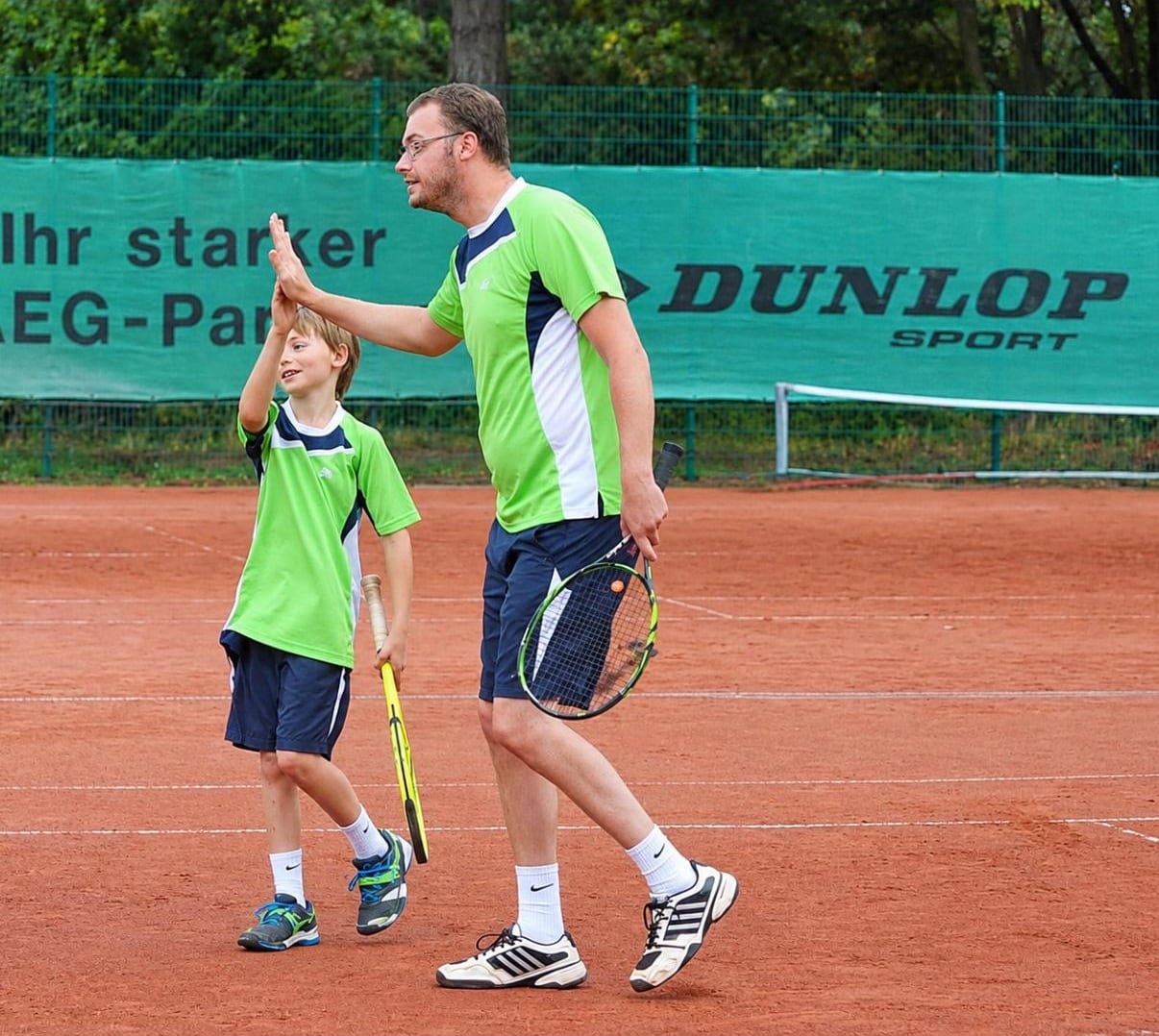
Björn Faber und Cedric als Kind klatschen sich auf dem Tennisplatz ab
Es geht um den Spaß · Vater und Sohn, damalsIt's about the fun · father and son, back then

Das Kind spielt gut. Die Eltern wollen helfen. Und nach ein paar Jahren besteht die Hälfte aller Gespräche aus Tabellen, Trainern und dem letzten Match.

Nicht weil jemand etwas falsch macht. Sondern weil sich das Reden auf das verlagert, worüber sich leicht reden lässt. Alles andere — Erwartung, Enttäuschung, die Frage, ob das eigentlich noch Spaß macht — bleibt liegen. Meistens jahrelang.

Und es bleibt selten zwischen zweien. Wenn ein Kind unter Erwartung steht, verschiebt sich auch etwas zwischen den Eltern — ob sie zusammenleben oder nicht.

Besonders eng wird es, wenn die gemeinsame Zeit knapp ist. Wer sein Kind nur zwei Wochen am Stück sieht, lädt diese Zeit auf. Dann ist ein schlechtes Training kein schlechtes Training mehr, sondern eine verlorene Stunde von wenigen. Fast alle getrennt lebenden Eltern bauen die Beziehung um den Sport herum — weil der Sport eine Struktur hat und Gespräche keine.

Und irgendwann sucht das Kind die Anerkennung nicht mehr nur zu Hause, sondern bei Trainern, Mitspielern, Zuschauern. Der Blick geht nach außen und findet dort nicht, was innen fehlt.

Und manchmal sind es zwei Messlatten statt einer — wenn die Eltern sich nicht einig sind, ob der Sport zählt oder die Schule. Dann kann es das Kind keinem recht machen, egal was es tut.

Ihr bekommt dieses Gespräch zurück. Auf dem Platz, weil man sich dort nicht gegenübersitzt — und ohne dass einer von euch beiden den Anfang machen muss.

The child is good. The parents want to help. And after a few years, half of every conversation is about rankings, coaches and the last match.

Nobody is doing anything wrong. It's just that talking drifts towards whatever is easy to talk about. Everything else — expectation, disappointment, the question of whether this is still fun — gets left. Usually for years.

And it rarely stays between two people. When a child is carrying expectation, something shifts between the parents as well — whether they live together or not.

It gets tightest when shared time is scarce. If you only see your child for two weeks at a stretch, that time gets loaded. A bad session stops being a bad session and becomes one lost hour out of very few. Almost all separated parents build the relationship around sport — because sport has a structure and conversations don't.

And at some point the child stops looking for recognition only at home and starts looking for it from coaches, team-mates, spectators. The gaze turns outward and doesn't find there what is missing inside.

And sometimes there are two measuring sticks instead of one — when the parents can't agree whether sport counts or school does. Then the child cannot get it right for anyone, whatever they do.

You get that conversation back. On court, because there you sit side by side instead of face to face — and neither of you has to be the one who starts it.

Warum von außenWhy from outside

Als Vater gibt es Grenzen

There are limits to being the father

Zwischen uns hat nie jemand etwas gesagt. Björn hat es gespürt, Cedric hat es gespürt — jeder etwas anderes, jahrelang.

Björn hat das Gespräch früh angeboten. Angenommen hat Cedric es Jahre später. Dazwischen ließ sich nichts beschleunigen — und es war trotzdem richtig, die Tür offen zu halten.

Ein Elternteil kann dieses Gespräch nicht erzwingen. Es kann es nur möglich machen und warten. Und irgendwann ist es selbst nicht mehr die richtige Person dafür — nicht weil es versagt hat, sondern weil es der Vater ist. Maßstab und neutraler Gesprächspartner in einer Person geht nicht. Das ist keine Schwäche, das ist Statik.

Nobody between us ever said anything. Björn felt it, Cedric felt it — each of us something different, for years.

Björn offered the conversation early. Cedric took it up years later. In between, nothing could be hurried — and it was still right to keep the door open.

A parent cannot force this conversation. They can only make it possible and wait. And at some point they are no longer the right person for it — not because they failed, but because they are the father. You cannot be the measuring stick and the neutral party at once. That isn't a weakness, it's structural.

Vertrauen ist der ganze Rest. In den Prozess — und in das Kind.

Trust is all the rest. In the process — and in the child.

Anstoßen und abwarten, bis beide Seiten so weit sind. Das kann lange dauern. Und es kann sein, dass es nie passiert — auch das muss man aushalten können, sonst wird aus dem Angebot wieder Druck. Wer die Tür offen hält, hat sie offen gehalten. Das ist keine Kleinigkeit: Es ist der Unterschied zwischen einem Kind, das weiß, dass es kommen könnte, und einem, das es nicht weiß.

Offer it, then wait until both sides are ready. That can take a long time. And it may never happen — you have to be able to bear that too, or the offer turns back into pressure. Whoever holds the door open has held it open. That is not nothing: it is the difference between a child who knows it could come, and one who doesn't.

„Eigentlich wollte ich mir im Sport mein eigenes Ding aufbauen. Gleichzeitig hing aber viel zu viel davon ab, was andere — und besonders du — von mir denken."

"What I really wanted was to build my own thing in sport. At the same time, far too much depended on what other people — and you in particular — thought of me."

Cedric, über die Jahre davor. Aufgeschrieben, bevor wir dieses Angebot gebaut haben. Ein Vorwurf steht darin nicht — kein einziger.

Cedric, on the years before. Written down before we built any of this. There isn't a single reproach in it.

Was du davon hastWhat you get out of it

Was nach anderthalb Tagen anders ist

What is different after a day and a half

Du weißt, woran du bist

You know where you stand

Du hörst einmal ungefiltert, wie dein Kind die letzten Jahre erlebt hat. Und dein Kind hört, was du eigentlich gemeint hast. Beides überrascht fast immer beide Seiten.

You hear, once and unfiltered, how your child experienced the last few years. And your child hears what you actually meant. Both sides are almost always surprised.

Der Druck sinkt messbar

The pressure comes down

Wenn ausgesprochen ist, was erwartet wird, hört das Raten auf. Die meisten Kinder spielen danach freier — nicht weil sie weniger wollen, sondern weil sie nicht mehr für zwei Menschen gewinnen müssen.

Once expectations are said out loud, the guessing stops. Most kids play more freely afterwards — not because they want it less, but because they're no longer winning for two people.

Ihr habt wieder ein Thema

You have something to talk about

Etwas Gemeinsames, das nichts mit Leistung zu tun hat — und drei Monate lang jemanden, den du anrufen kannst, wenn es wieder kippt.

Something shared that has nothing to do with performance — and for three months, someone you can call when it tips again.

Was wir nicht versprechen: dass danach alles gut ist. Wir versprechen, dass das Gespräch stattfindet. Den Rest macht ihr beide.

What we don't promise: that everything is fine afterwards. We promise the conversation happens. The rest is down to the two of you.

Unser AnsatzOur approach

Startaufstellung, Platzkarte, vier Fragen

Line-up, Court Map, four questions

Wir arbeiten nach einem eigenen, kleinen Raster. Drei Teile, mehr nicht. Alle drei stehen vollständig auf dieser Seite — du sollst vorher wissen, was passiert.

We work to a small framework of our own. Three parts, that's all. All three are set out in full on this page — you should know beforehand what happens.

Teil 1 · Vorher, getrenntPart 1 · Beforehand, separately

Die Startaufstellung

The Line-up

Sieben Fragen, für beide dieselben, getrennt voneinander beantwortet. Zehn Minuten, handschriftlich. Der Abstand zwischen euren beiden Antworten ist unser eigentliches Material — meistens steht die Sitzung darin schon fest, bevor sie beginnt.

Seven questions, identical for both of you, answered separately. Ten minutes, by hand. The gap between your two answers is what we actually work with — usually the session is already there before it starts.

Teil 2 · Wo ihr stehtPart 2 · Where you stand

Die Platzkarte

The Court Map

Vier Positionen, die wir immer wieder sehen — auf dem Platz und zu Hause. In den ersten Minuten wisst ihr, auf welcher steht ihr. Wir stehen selbst mit drauf.

Four positions we see again and again — on court and at home. Within minutes you know which one you're on. We're on it ourselves.

Teil 3 · Im GesprächPart 3 · In the conversation

Die vier Fragen

The four questions

Immer dieselben, immer in derselben Reihenfolge. Wir wissen nicht, was rauskommt — wir wissen genau, was wir fragen.

Always the same, always in the same order. We don't know what will come out — we know exactly what we ask.

HerkunftOrigin

Selbst gebaut, an einer Familie erprobt

Built ourselves, tested on one family

Kein Lizenzmodell, keine Ausbildung, kein Lehrbuch. Entstanden aus drei Generationen in einer Familie — und aus allem, was vorher nicht gereicht hat.

No licensed model, no certification, no textbook. It came out of three generations in one family — and out of everything that wasn't enough before.

Teil 2 · Wo ihr gerade stehtPart 2 · Where you stand right now

Die Platzkarte

The Court Map

Im Doppel — ob Padel oder Tennis — verliert das Paar, das auseinandersteht. Vier Positionen sehen wir immer wieder — auf dem Platz und zu Hause. Keine davon ist falsch. Man kann nur nicht darin stehenbleiben.

In doubles — padel or tennis — the pair that stands apart loses the point. We see four positions again and again — on court and at home. None of them is wrong. You just can't stay in them.

Beide hinten

Both at the back

Ihr redet viel und sagt wenig. Ergebnisse, Trainer, Termine — und keiner geht ran.

You talk a lot and say little. Results, coaches, fixtures — and neither of you moves up.

Björn & Großvater, dreißig Jahre langBjörn & Grandfather, for thirty years

Einer vorn, einer hinten

One up, one back

Einer treibt, einer weicht aus. Je mehr der eine drängt, desto weiter geht der andere zurück.

One pushes, the other retreats. The harder one presses, the further back the other goes.

Björn & Cedric, bis Cedric gingBjörn & Cedric, until Cedric left

Beide im Niemandsland

Both in no man's land

Es läuft irgendwie, aber keiner weiß, wohin. Kein Streit, keine Richtung, viel Unruhe.

It works, somehow, but nobody knows where it's going. No fighting, no direction, a lot of unease.

Der häufigste Zustand bei AnrufThe most common state when people call

Als Doppel

As a pair

Beide vorn, jeder deckt seine Seite. Selten — und fast nie ohne eine Krise davor.

Both up, each covering their side. Rare — and almost never without a crisis first.

Da wollen wir hinWhere we're headed
ElternteilParentKindChildNetz oben · eure HälfteNet at top · your half

Wir stehen selbst auf dieser Karte, und nicht auf dem schönen Feld. Deshalb schreiben wir dazu, wo wir waren. Und die Karte gilt unabhängig vom Alter: Ein 45-jähriger Sohn und sein 78-jähriger Vater stehen auf denselben vier Positionen.

We're on this map ourselves, and not on the good square. That's why we've written in where we stood. And the map holds regardless of age: a 45-year-old son and his 78-year-old father stand on the same four positions.

Warum auf dem PlatzWhy on court

Auf dem Platz fällt es leichter

It comes easier on court

Auf Augenhöhe

As equals

Im Doppel deckt jeder seine Seite. Auf dem Padelplatz geht das am leichtesten — dort können ein 50-Jähriger und ein 18-Jähriger echte Partner sein. Auf dem Tennisplatz genauso, wenn beide spielen. Nicht Elternteil trainiert Kind. Nicht Kind nimmt Rücksicht. Zwei Partner.

In doubles each of you covers a side. Padel makes that easiest — there a 50-year-old and an 18-year-old can be genuine partners. On a tennis court it works just as well if you both play. Not parent coaching child. Not child going easy on parent. Two partners.

Man sieht es sofort

You see it straight away

Wer entschuldigt sich nach jedem Fehler? Wer sagt ungefragt, wie es besser geht? Wer holt den Ball, der dem anderen gehört? Nach 45 Minuten liegt das auf dem Tisch, ohne dass es jemand erzählen musste.

Who apologises after every mistake? Who gives advice nobody asked for? Who takes the ball that belongs to the other one? After 45 minutes it's all on the table, and nobody had to say a word.

Reden beim Gehen

Talking while moving

Junge Leute reden im Gehen und im Spielen, nicht gegenübersitzend. Deshalb machen wir es so. Ganz einfach.

Young people talk while walking and while playing, not sitting across a table. That's the whole reason. Nothing clever about it.

Gespielt wird auf dem Padel- oder Tennisplatz, je nachdem, was euch liegt. Wir arbeiten in Fußball, Tennis und Padel — weil wir den Wettkampfalltag, den Umgang mit Trainern und den Ranglistendruck in allen dreien selbst erlebt haben. Björn im Tennis, Cedric im Padel, Großvater im Fußball.

You play on a padel or a tennis court, whichever suits you. We work in football, tennis and padel — because we have lived the competitive week, the coach relationship and ranking pressure in all three ourselves. Björn in tennis, Cedric in padel,Grandfather in football.

Der kleine AnfangThe small start

Das Einspielen

The Warm-Up

Eine Stunde spielen, danach zusammen etwas trinken. Ihr als Doppel, wir auf der anderen Seite. Kein Fragebogen, kein Gespräch, keine Auswertung — außer ihr fragt danach.

An hour of playing, then a drink together. The two of you as a pair, us on the other side. No questionnaire, no session, no debrief — unless you ask for one.

Kein Training

Not a lesson

Wir korrigieren keine Technik und geben keine Anweisungen. Wir stehen auf der anderen Seite des Netzes, nicht hinter eurem Kind. Vorkenntnisse braucht ihr keine.

We don't correct technique and we don't give instructions. We stand on the other side of the net, not behind your child. No prior experience needed.

Kein Eingeständnis

Nothing to admit

Ihr müsst nicht erklären, dass etwas nicht stimmt. Beim Einspielen zählt nichts — so wie vor einem Match. Wer danach mehr will, sagt es. Wer nicht, hat eine Stunde zusammen gespielt.

You don't have to explain that something is wrong. In a warm-up nothing counts — just like before a match. If you want more afterwards, say so. If not, you've had an hour on court together.

Auch für uns eine Probe

A test for us too

Wir sehen auf dem Platz schnell, ob wir euch helfen können — und sagen es euch ehrlich, auch wenn die Antwort nein lautet. Und ihr seht, ob ihr uns mögt. Das ist mindestens genauso wichtig.

On court we see quickly whether we'd be any use to you — and we'll say so honestly, even if the answer is no. And you see whether you like us. That matters just as much.

Padel oder Tennis, in eurer Nähe. Wenn daraus ein Doppel wird, rechnen wir das Einspielen an.

Padel or tennis, near you. If it turns into a Double, we credit the Warm-Up against it.

Ablauf · anderthalb Tage · ein Elternteil, ein KindHow it works · a day and a half · one parent, one child

Wie es abläuft

The sequence

  1. Die Startaufstellung

    The Line-up

    Ein Blatt, sieben Fragen, für beide dieselben. Getrennt ausgefüllt, mit der Hand, zehn Minuten. Was dein Kind schreibt, siehst du nicht — außer es gibt es frei.

    One sheet, seven questions, identical for both. Filled in separately, by hand, ten minutes. You don't see what your child writes — unless they release it.

  2. Zwei Telefonate, getrennt

    Two calls, separately

    Erst der Elternteil mit Björn, dann das Kind mit Cedric. Je 45 Minuten. Was gesagt wird, bleibt dort. Kostenlos, unverbindlich.

    First the parent with Björn, then the child with Cedric. 45 minutes each. What's said there stays there. Free, no obligation.

  3. Was gesagt werden darf

    What may be shared

    Am Ende jedes Telefonats klären wir: Was davon darf ich mitnehmen? Nur das kommt später auf den Tisch. Ohne diesen Punkt fangen wir nicht an.

    At the end of each call we agree what we're allowed to bring into the room. Only that comes up later. Without this step we don't start.

  4. Ihr spielt

    You play

    Elternteil und Kind als Doppel, 45 Minuten, auf dem Padel- oder Tennisplatz. Wir spielen dagegen. Auf Wunsch mit Kamera, sonst ohne. Wenn Spielen nicht geht — aus Alter, Verletzung oder Unlust — gehen wir stattdessen. Der Rest bleibt gleich.

    Parent and child as a doubles pair, 45 minutes, on a padel or tennis court. We play against you. Filmed if you want it, otherwise not. If playing isn't possible — age, injury, or simply not wanting to — we walk instead. Everything else stays the same.

  5. Danach reden wir

    Then we talk

    Im Gehen oder auf der Bank am Platz. Erst was passiert ist, dann was das über euch sagt, dann was davon zu Hause auch gilt.

    Walking, or on the bench by the court. First what happened, then what it says about you, then how much of it is true at home too.

  6. Das eigentliche Gespräch

    The actual conversation

    Anderthalb bis zwei Stunden. Drei Regeln: in der ersten Stunde kein Wort über Ergebnisse. Der Elternteil sagt „ich", nicht „wir". Das Kind bestimmt, welches Thema zuerst kommt. Am Schluss schreibt jeder seinen Matchplan, ihr tauscht die Blätter.

    Ninety minutes to two hours. Three rules: not a word about results in the first hour. The parent says "I", not "we". The child decides which subject comes first. At the end each of you writes a Match Plan and you swap the sheets.

  7. Drei Monate danach

    Three months after

    Bis zu drei Nachbesprechungen, persönlich, im Preis enthalten. Zum Schluss nur noch eine einzige Frage aus der Startaufstellung: Wo steht ihr jetzt auf der Platzkarte? Ein Kreuz, keine Skala. Ohne diesen Nachlauf verpufft es in drei Wochen.

    Up to three follow-up conversations, in person, included in the price. At the end just one question from the Line-up: where are you on the Court Map now? One tick, no scale. Without this follow-up it fades in three weeks.

Teil 3 · Was wir im Gespräch fragenPart 3 · What we ask in the conversation

Vier Fragen im Gespräch

Four questions in the conversation

Wir wissen nicht, was rauskommt. Wir wissen genau, was wir fragen. Hier stehen die Fragen vollständig — du sollst sie vorher kennen, nicht im Termin überrascht werden.

We don't know what will come out. We know exactly what we ask. Here they are in full — you should know them beforehand, not be surprised on the day.

Diese vier Fragen sind nicht aus einem Buch. Wir haben vorher das genommen, was es gibt — Therapie, Coaching, Hypnose, Retreats im Ausland. Vieles davon war gut, und nichts davon war verschwendet. Nur war es immer Arbeit an einem von uns beiden. Das Problem lag zwischen uns.

Nichts davon konnte einer allein lösen, egal wie tief er ging. Es braucht ein Format, in dem beide im selben Raum stehen. Also haben wir uns unser eigenes gebaut — klein, unfertig, und an genau einer Familie erprobt: an unserer.

These four questions are not from a book. We tried what's out there first — therapy, coaching, hypnosis, retreats abroad. Much of it was good, and none of it was wasted. But all of it was work on one of us. The problem sat between us.

None of it could be solved by one person alone, however deep they went. It needs a format where both are in the same room. So we built our own — small, unfinished, and tested on exactly one family: ours.

  1. Wessen Maßstab liegt hier eigentlich — und nach wessen Prinzipien lebt ihr gerade?Whose measuring stick is this — and whose principles are you living by?
  2. Was wird bei euch vorausgesetzt und ist nie gesagt worden?What is taken for granted between you and has never been said?
  3. Wo ist das eigene Feld, auf dem dein Kind nicht gegen dich antreten muss?Where is the field of their own, where your child doesn't have to compete against you?
  4. Was passiert bei euch, wenn es eng wird?What happens between you when it gets tight?

Vier Fragen sind ehrlicher als fünf Säulen, weil eine Frage nichts behauptet. Wir haben sie zuerst an uns selbst beantwortet — einmal für Björn und Großvater, einmal für Björn und Cedric. Beide Male kam etwas Unangenehmes heraus. Deshalb trauen wir ihnen.

Four questions are more honest than five pillars, because a question claims nothing. We answered them on ourselves first — once for Björn and Grandfather, once for Björn and Cedric. Both times something uncomfortable came out. That's why we trust them.

Wenn dein Kind zumachtWhen your child shuts down

Für wen das ist

Who this is for

Familien mit Sportlerkindern — Fußball, Tennis, Padel. Ab 14, und nach oben ohne Altersgrenze: Auch erwachsene Kinder mit älteren Eltern stehen auf denselben vier Positionen.

Families with children in sport — football, tennis, padel. From 14 upwards, and no upper age limit: grown-up children with older parents stand on the same four positions.

Bei euch zu Hause, im eigenen Verein oder auf einer Anlage in der Nähe. Vertraulich, nur ihr zwei und wir. Keine Gruppe, keine anderen Familien, keine Namen irgendwo.

Und es funktioniert auch spät. Ein 45-jähriger Sohn und ein 78-jähriger Vater sitzen auf denselben vier Positionen wie ein Sechzehnjähriger und sein Trainervater. Das Ungesagte wird mit den Jahren nicht kleiner, nur leiser. Zwischen Björn und seinem Vater wurde über all das jahrzehntelang nicht gesprochen. Irgendwann doch.

Wenn Spielen nicht mehr geht, wird gegangen. Die Platzkarte braucht keinen Schläger, und der Debrief funktioniert auf einer Bank am Zaun genauso.

Where you live, at your club, or on a court nearby. Private — just the two of you and us. No group, no other families, no names anywhere.

And it works late, too. A 45-year-old son and a 78-year-old father stand on the same four positions as a sixteen-year-old and his coaching father. What goes unsaid doesn't get smaller over the years, only quieter. Between Björn and his own father, none of it was discussed for decades. Then, eventually, it was.

If playing is no longer on, we walk instead. The Court Map needs no racket, and the debrief works just as well on a bench by the fence.

Ein Ablauf, drei EinstiegeOne process, three ways in

Womit ihr anfangt

Where you start

Der Ablauf ist immer derselbe. Nur der Einstieg ist ein anderer: das Einspielen, die Telefonate oder gleich das Doppel.

The process is always the same. Only the way in differs: the warm-up, the calls, or straight into the Double.

Das EinspielenThe Warm-Upeine Stunde auf dem Platz, ohne Programm — der einfachste Anfangan hour on court, no programme — the easiest way in
Zwei TelefonateTwo callsgetrennt, je 45 Minutenseparate, 45 minutes each
Das DoppelThe Doubleanderthalb Tage, ein Elternteil, ein Kinda day and a half, one parent, one child
Drei Monate danachThree months afterein Termin im Monatone session per month

Die beiden Telefonate kosten nichts. Was ein Doppel bei euch kostet, besprechen wir im ersten Gespräch — bevor du irgendetwas zusagst.

The two calls cost nothing. What a Double costs for you, we discuss in that first call — before you commit to anything.

Bei Minderjährigen brauchen wir die schriftliche Zustimmung beider Sorgeberechtigten. Dein Kind kann jederzeit abbrechen, auch mitten im Termin und auch dann, wenn schon bezahlt ist.

For minors we need written consent from both legal guardians. Your child can stop at any point — mid-session, and even after payment.

VerbindlichBinding

Worauf du dich verlassen kannst

What you can rely on

Offen heißt nicht unverbindlich. Über das Ergebnis können wir nichts versprechen — über das Verfahren alles.

Open does not mean non-committal. We can promise nothing about the outcome — and everything about the process.

Damit du weißt, worauf du dich einlässtSo you know what you are getting into

Was wir nicht sind

What we are not

Häufige FragenCommon questions

Was Eltern uns zuerst fragen

What parents ask us first

Mein Kind will mit dem Sport aufhören — was mache ich?

My child wants to quit the sport — what do I do?

Erst herausfinden, ob es der Sport ist oder das, was drumherum passiert. Meistens ist es das Zweite. Genau dafür sind die zwei getrennten Telefonate da.

First find out whether it's the sport or what surrounds it. Usually it's the second. That's exactly what the two separate calls are for.

Wie viel Druck ist im Leistungssport zu viel?

How much pressure is too much in youth sport?

Es gibt keine Zahl. Ein brauchbares Zeichen: Wenn dein Kind nach einer Niederlage zuerst an deine Reaktion denkt und nicht an das Spiel, ist es zu viel.

There's no number. A usable sign: if after a loss your child thinks about your reaction before the match itself, it's too much.

Mein Sohn redet nicht mehr mit mir. Ist das normal?

My son doesn't talk to me any more. Is that normal?

Zwischen 15 und 22 sehr oft, ja. Problematisch wird es, wenn ihr euch ausschließlich noch über Leistung verständigt — dann bricht die Verbindung weg, sobald die Leistung wegbricht.

Between 15 and 22, very often, yes. It becomes a problem when performance is the only thing you still communicate through — then the connection goes the moment the performance does.

Uns geht es eigentlich gut. Passt das trotzdem?

Things are fine with us. Does this still fit?

Ja — und ehrlich gesagt ist das der bessere Zeitpunkt. Wenn gerade Krise ist, wiegt jeder Satz zu viel. Wenn es ruhig ist, lässt sich reden. Dafür ist das Einspielen da: eine Stunde spielen, mehr nicht.

Yes — and honestly, that's the better moment. In a crisis every sentence weighs too much. When things are calm, you can actually talk. That's what the Warm-Up is for: an hour of playing, nothing more.

Muss es Padel sein?

Does it have to be padel?

Nein. Padel oder Tennis, wie ihr wollt — Björn hat Tennis auf Ranglistenniveau gespielt, Cedric spielt Padel. Vorkenntnisse braucht ihr nicht. Anfänger sind sogar oft besser, weil dann keiner der beiden im Vorteil ist.

No. Padel or tennis, whichever you prefer — Björn played tennis at ranking level, Cedric plays padel. You need no prior experience. Beginners are often better, because then neither of you has the advantage.

Was, wenn mein Kind nicht mitkommen will?

What if my child doesn't want to come?

Dann kommt es nicht. Wir überreden niemanden — das erste Telefonat mit Cedric ist völlig unverbindlich, und danach entscheidet dein Kind selbst.

Then they don't. We don't talk anyone into it — the first call with Cedric commits to nothing, and after that your child decides.

Mein Kind ist längst erwachsen — ist es zu spät?

My child is grown up long ago — is it too late?

Nein. Wir arbeiten mit Vierzehnjährigen und mit Fünfzigjährigen. Bei erwachsenen Kindern und alten Eltern kommt allerdings etwas dazu, das man aussprechen sollte: Die Tür ist dann nicht mehr unbegrenzt offen. Das ist kein Druckmittel, sondern schlicht wahr.

No. We work with fourteen-year-olds and with fifty-year-olds. With grown children and elderly parents there is one thing worth saying out loud, though: the door is no longer open indefinitely. That isn't a sales tactic, it's simply true.

Mein Vater kann keinen Sport mehr machen.

My father can't play any more.

Dann wird gegangen statt gespielt. Der Platz ist nur der Ort, an dem man nebeneinander steht statt gegenüber — das geht auch beim Gehen. Alles andere am Ablauf bleibt gleich.

Then we walk instead of playing. The court is only the place where you stand side by side rather than face to face — walking does that too. Everything else in the sequence stays the same.

Ist das eine Therapie?

Is this therapy?

Nein. Wir sind selbst durch Therapie gegangen und halten sie für richtig, sind aber nicht dafür ausgebildet. Wo Behandlung nötig ist, hören wir auf und vermitteln weiter.

No. We've been through therapy ourselves and think it's right, but we're not trained to do it. Where treatment is needed we stop and refer on.

Der erste SchrittFirst step

Schreib uns zwei Sätze

Send us two sentences

Du hast bis hierhin gelesen. Dann schreib uns zwei Sätze: wer du bist und worum es geht. Wir melden uns innerhalb von zwei Tagen und machen zwei Termine aus — einen mit dir, einen mit deinem Kind. Kostenlos.

You have read this far. So send us two sentences: who you are and what this is about. We come back within two days and set up two calls — one with you, one with your child. Free.

TelefonPhone+49 177 4638184
WoWhereErkrath · Düsseldorf · Köln — und überall, wo es einen Platz gibtErkrath · Düsseldorf · Cologne — and anywhere with a pitch or a court